



 July 2, 2026
 Dryer Repair in St. Pete, Common Problems & What to Do
A broken dryer has a way of becoming a bigger problem than it first appears. What starts as “the clothes are still a little damp” turns into three cycles per load, then the dryer stops heating altogether, and suddenly you’re hanging things around the house waiting for them to dry. Sound familiar?
If you’re in St. Petersburg and need someone to take a look, our appliance service in Saint Petersburg is available for same-week appointments. But before you call anyone, here’s what’s most likely going on and what you can do about it.
What Causes a Dryer to Stop Heating?
No heat is the most common dryer complaint we hear, and the good news is it almost always comes down to one of three things.
Burned-out heating element
On electric dryers, this is the part that actually generates the heat. It rarely fails all at once — usually it starts producing less heat over time, which is why you might notice clothes taking longer to dry before the problem becomes obvious. Eventually it gives out completely and the dryer just runs cold.
Blown thermal fuse
Think of this as the dryer’s safety switch. When the machine overheats, the thermal fuse trips — and unlike a circuit breaker, it doesn’t reset itself. The dryer simply stops heating until the fuse is replaced. One important thing to know: a blown fuse is usually a symptom of something else, like a blocked vent causing the dryer to overheat. Replace the fuse without fixing the underlying cause and it’ll blow again.
Weak igniter (gas dryers)
On gas dryers, the igniter lights the burner. As it ages, it loses the ability to get hot enough to open the gas valve reliably, so the burner either doesn’t light or keeps cutting out. The machine runs, the drum turns, but nothing actually gets warm.
All three are fixable. The trick is testing each one properly to find the actual culprit rather than replacing parts by guesswork.
Why Is My Dryer Making a Grinding or Squealing Noise?
Dryers are pretty communicative when something is wearing out, you just need to know what the sounds mean.
Grinding. That metal-on-metal scraping sound usually means the drum seal has worn through and the drum is making direct contact with the machine’s housing. It can also point to a failing drum bearing. Either way, keep using the dryer and you’ll turn a straightforward repair into a much more expensive one, metal contact damages surrounding components fast.
Squealing. That high-pitched squeal during the cycle is almost always the drum support rollers or the idler pulley wearing out. These are the parts that keep the drum spinning smoothly, and they wear gradually, the noise usually starts faint and gets worse week by week until it becomes impossible to ignore.
Neither of these means you need a new dryer. They’re normal wear items, the parts are readily available for most brands, and the repair is usually straightforward.
Why Is My Dryer Shutting Off Early?
If your dryer starts up fine but stops after a few minutes, it’s almost certainly overheating and the most likely reason is a blocked exhaust vent.
When lint builds up in the vent duct, hot air can’t escape fast enough. The temperature inside the dryer climbs, the thermal cutoff trips to protect the machine, and the dryer shuts down. You restart it, it runs for a few minutes, the same thing happens again. It’s a frustrating loop.
The fix sounds simple, clear the vent, and often it is. Check the hose at the back of the machine for kinks, and step outside to make sure the exterior vent flap is actually opening when the dryer is running. If the vent is clear and it’s still shutting off, the thermostat or thermal cutoff components need to be tested.
What makes this worth taking seriously: running a dryer that keeps overheating puts real stress on the heating element and motor. A vent cleaning job left too long can quietly become a heating element replacement.
Why Does My Dryer Smell Like It’s Burning?
Stop using it. Right now.
A burning smell isn’t something to keep an eye on or run one more cycle to see if it goes away. Lint is highly flammable, and a dryer that smells like burning is telling you that something inside is either already scorching or very close to it.
Here’s what to do immediately:
- Turn the dryer off and unplug it
- Do not run another cycle
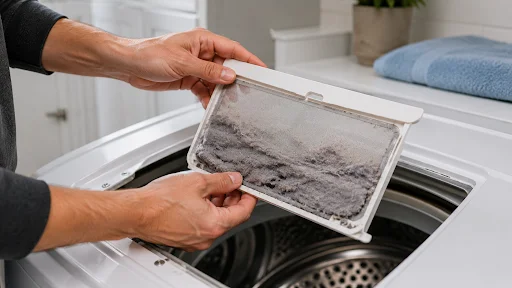
- Check the lint trap if it’s packed, clear it and look for buildup around the trap housing
- Check the vent hose for blockages or crushing
If the lint trap and vent look fine and the smell was coming from inside the machine, that’s an internal problem, a failing heating element, a motor fault, or lint that’s accumulated in areas you can’t access yourself. Call a technician before using the dryer again. Dryer fires are real, and they’re not worth the risk.
What to Do if Dryer Won’t Start
There’s nothing more frustrating than pressing Start and getting absolutely nothing. Before assuming something is broken inside the machine, run through these checks, they solve the problem more often than you’d expect.
Step 1 – Check the breaker
Electric dryers run on a 240-volt circuit with two separate breakers. If one trips, the dryer might look like it has power, the display lights up, the door light works – but it won’t run. Go to your electrical panel, find both dryer breakers, and reset them fully even if they don’t look tripped.
Step 2 – Check the power cord
Pull the dryer forward slightly and make sure the plug is seated fully in the outlet. A partially loose plug on a 240-volt outlet can produce the same half-powered symptom as a tripped breaker.
Step 3 – Test the door switch
Close the door and listen for a click. The dryer won’t start if it doesn’t register the door as fully shut – it’s a built-in safety feature. No click when the door closes almost always means the switch has failed and needs replacing.
Step 4 – Check the start button itself
If the motor doesn’t even hum when you press Start, and the power and door switch are both fine, the start switch may have worn out. This is less common but happens on older machines.
If none of these point to the problem, the fault is likely internal, a failed motor or a control board issue that needs a technician to diagnose properly.
How to Fix a Dryer That Won’t Spin
A drum that doesn’t move is usually a mechanical problem rather than an electrical one — and the most common cause is something you can confirm without taking the whole machine apart.
Step 1 – Listen when you press Start
If the motor hums but the drum doesn’t move, the drive belt has almost certainly snapped. The belt connects the motor to the drum, and when it breaks, the motor runs normally while the drum just sits there.
Step 2 – Try turning the drum by hand
With the dryer off and unplugged, open the door and try rotating the drum manually. If it spins freely with almost no resistance, that’s a strong indicator the belt is gone, a drum with an intact belt has some tension when you turn it.
Step 3 – Check for obstructions
Occasionally something gets caught between the drum and the dryer housing, a sock, a small garment, a lost item from a pocket. Check around the drum edge before assuming the belt is the cause.
Step 4 – If the drum won’t turn at all
If the drum feels completely locked rather than loose, the problem is more likely a seized drum bearing or a motor fault rather than a broken belt. Either way, this needs a technician, forcing a locked drum risks damaging the shaft or housing.
Replacing a drive belt is one of the more approachable dryer repairs for someone comfortable with basic disassembly. But if the diagnosis isn’t clear after these steps, a professional visit will get you a definitive answer without the risk of replacing the wrong part.
Dryer Takes Too Long to Dry Is It the Dryer or the Vent?
Here’s something that surprises a lot of people: when a dryer takes two or three cycles to dry a normal load, the dryer is often working fine. The vent is the problem.
A partially blocked exhaust vent restricts airflow enough to make a big difference in drying time without stopping the dryer from running at all. The machine heats up, the drum turns, but moisture has nowhere to go fast enough. Check the vent hose for kinks and confirm the exterior flap is opening freely.
If the vent is clear, try wiping the moisture sensor bars inside the drum with a little rubbing alcohol. These are two small metal strips that detect when clothes are dry, and fabric softener residue builds up on them over time, causing the dryer to end the cycle before the load is actually done. Two minutes with a cotton pad can solve the problem entirely.
If neither of those is the cause, a heating element that’s partially failing, producing some heat but not enough, is the likely explanation.
How Often Should a Dryer Vent Be Cleaned in Pinellas County?
Most guides say once a year. In Pinellas County, that’s probably not often enough.
Florida’s humidity means the lint inside dryer vents holds more moisture than it would somewhere drier. Damp lint compacts faster and blocks vents on a shorter timeline than the standard annual recommendation assumes. On top of that, homes near the water in St. Pete and Clearwater deal with salt air that corrodes vent flaps and exterior fittings over time, making them less effective at expelling air even when the duct itself is clear.
For most households here running the dryer regularly, every six months is a more realistic cleaning schedule. And for older St. Pete homes where the laundry room isn’t on an exterior wall, meaning longer vent runs with more bends, professional cleaning is worth considering over DIY, since partial cleaning of a long run can leave blockages deeper in the duct where they’re harder to spot.
Our dryer repair service includes a full diagnostic visit for $89, credited toward the repair if you go ahead, so you know exactly what you’re dealing with before making any decisions.
Is It Worth Repairing a Dryer in St. Pete?
Honestly, for most dryers under 10 years old — yes, without much hesitation. Heating elements, thermal fuses, drive belts, drum rollers, igniters, door switches — these are all inexpensive parts relative to the cost of a new machine, and replacing them brings the dryer back to full working condition.
Between 10 and 12 years old, it depends on what failed. A straightforward repair on a machine that’s been reliable is still a reasonable investment. A motor or control board replacement on a dryer that’s already had a few repairs is a closer call.
Over 12 years with a major component failure, it’s worth having an honest conversation about whether repair makes financial sense before committing. We’ll always give you that straight answer before any work starts.
FAQs
Can I Clean My Dryer Vent Myself or Do I Need a Professional?
For short, straight vent runs with easy access, a DIY cleaning kit does the job. For longer runs, multiple bends, or vents that haven’t been touched in a few years, professional cleaning is more thorough and makes sure blockages deeper in the duct are actually cleared rather than just pushed further in.
My Dryer Works Fine on Air-Dry But Won’t Heat on Any Other Setting, What’s Wrong?
That’s a classic thermal fuse or heating element symptom on electric dryers. The motor and drum are working fine, it’s just the heating circuit that’s failed. It’s one of the more straightforward dryer repairs and is usually done in a single visit.
How Do I Know if My Dryer Belt Is Broken?
The clearest sign is a motor that hums when you press Start but a drum that doesn’t move at all. You might also notice the start button feels different, less resistance than usual. A broken belt is confirmed visually once the machine is opened up, and it’s usually pretty obvious.
Is a Burning Smell From My Dryer Always Serious?
Yes, treat it as serious until proven otherwise. Stop using the dryer, unplug it, and check the lint trap and vent before doing anything else. If those are clear and the smell was internal, call a technician, don’t run another cycle to see if it goes away.
Do You Service Both Electric and Gas Dryers in St. Petersburg?
Yes, both. Gas dryer repairs involving the igniter, burner assembly, or gas valve need a technician with gas appliance experience, it’s one of those areas where DIY really isn’t the right call, regardless of how handy you are.