


 May 29, 2026
 Oven Not Reaching Temperature? How to Diagnose a Failing Heating Element
You set the oven to 375°F, wait for the preheat signal, and put your food in — only to find it’s barely cooked an hour later. Or maybe you’ve noticed your oven takes twice as long to preheat as it used to, or the temperature just never feels right. When an oven is running cool or not reaching the set temperature, the heating element is usually the first thing to investigate. But it’s not always the only culprit.
This guide walks you through how to tell if your oven heating element is bad, what other components could be causing the problem, and how to decide between a DIY fix and calling a professional.
What to Do If Your Oven Is Not Getting Hot Enough
Before calling anyone, work through these steps in order. They cover the most common causes and take about 10–15 minutes total.
Step 1. Check the temperature settings.
Make sure the oven is set to the correct mode (Bake, not Broil or Warm) and that the temperature hasn’t been accidentally lowered. Some ovens also have a calibration offset in the settings menu that can shift the actual temperature by 20–35 degrees without you realizing it.
Step 2. Inspect the heating element visually.
With the oven off and cooled, remove the racks and look closely at the bake element along the oven floor. Cracks, holes, burn marks, or blistering are a clear sign it has failed and needs replacing.
Step 3. Watch it heat up.
Set the oven to 350°F and observe through the window as it preheats. A healthy bake element glows uniformly red across its full length. If only part of it glows — or it doesn’t glow at all — it’s failing.
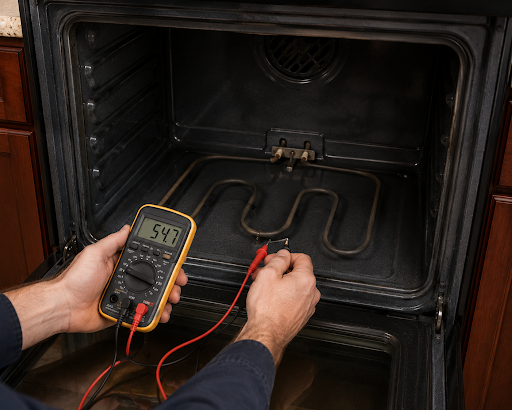
Step 4. Test the element with a multimeter.
Unplug the oven. Remove the element (two screws at the back wall of the cavity) and disconnect the wires. Set the multimeter to resistance mode and touch the probes to each terminal. A working element reads between 20 and 115 ohms. No reading means the element has failed.
Step 5. Check the temperature sensor.
If the element tests fine, move to the sensor probe in the upper back corner of the oven interior. At room temperature it should read around 1,080–1,100 ohms. A reading significantly outside that range means the sensor is faulty.
If you’ve worked through all five steps and nothing points to a clear fix, or you’re not comfortable with a multimeter, that’s the right moment to call a professional. Replacing a visually failed element on a standard electric range is a manageable DIY job. Everything beyond that: gas igniters, control boards, and sensor replacements on built-in models, is where an oven repair service will save you time, money, and the risk of replacing the wrong part.
Why Your Oven Isn’t Reaching Temperature: The Most Likely Causes
Before assuming the worst, it helps to know which component is actually failing. Several different parts can cause the same symptom – an oven that heats partially or inconsistently — and diagnosing the right one saves both time and money.
A Weak or Burned-Out Heating Element
In an electric oven, there are typically two elements: the bake element at the bottom of the oven cavity and the broil element at the top. When the bake element is failing, the oven either won’t heat at all or heats unevenly, taking much longer than normal to reach temperature.
Visible signs of a faulty oven heating element include:
- Visible damage — blistering, cracks, or a hole in the element coil
- Uneven glowing — a working element glows consistently red; a failing one may glow only in sections or not at all
- Dark spots — areas of the element that appear burned or discolored
If the element looks physically intact but you still suspect it, a multimeter test will confirm whether it has continuity. A reading of no continuity means the element has failed and needs replacing.
Replacing a bake or broil element is one of the more approachable oven repairs — the part is relatively inexpensive and accessible on most models. That said, the job involves working with electrical connections inside the oven cavity, and on some models, accessing the element requires more disassembly than it appears. If you’re not fully comfortable with the process, get a free consultation and let a technician assess what needs to be done before you commit to anything.
A Faulty Oven Temperature Sensor
The temperature sensor is a probe — usually located in the upper back corner of the oven interior — that monitors the actual temperature inside and communicates with the control board to regulate heating. When it fails or drifts out of calibration, the oven temperature becomes inaccurate: the control board thinks the oven is hotter than it is and cycles the element off too early.
This is one of the more common reasons an oven preheats but won’t maintain temperature during cooking. A faulty temperature sensor can be tested with a multimeter as well. At room temperature, most sensors read around 1,080–1,100 ohms; a reading significantly outside that range confirms the sensor needs replacing.
A Weak Oven Igniter (Gas Ovens)
If you have a gas oven that’s not heating properly, the igniter is the most likely cause. The igniter doesn’t just light the gas — it also acts as a safety valve trigger. When it weakens with age, it takes longer to reach the temperature needed to open the gas valve, which means less gas flows through and the oven runs cooler than set.
A weak igniter is one of the leading causes of a gas oven not reaching temperature, and it’s a common failure point on GE, Whirlpool, and Samsung gas ranges. Replacement requires shutting off the gas supply and working near the burner assembly, so unless you’re experienced with gas appliance repair, this is one best left to a technician.
The Control Board or Thermostat
If the sensor and elements test fine, the problem may be further upstream — in the control board or thermostat that governs the entire heating cycle. A failing oven thermostat can cause the oven to cycle incorrectly, heat inconsistently, or stop heating mid-cook without displaying any error code.
Control board issues are less common but harder to diagnose without the right equipment. They also vary significantly by brand — a Samsung oven with a control board fault will behave differently from a Bosch or KitchenAid with the same underlying problem, and the replacement parts and procedures differ accordingly.
If you’re in the Tampa Bay area and not sure where to start, our appliance repair in Saint Pete team is available for same-week diagnostics on all major oven brands and models.
How to Test if Your Oven Heating Element Is Bad
Not sure whether the element is actually the problem? Here’s a straightforward process to check before ordering parts or calling anyone.
Do a visual inspection.
With the oven completely off and cooled down, remove the oven racks and look closely at the bake element along the bottom. Any cracks, holes, blistering, or dark burned spots are a clear sign the element has failed.
Run a preheat observation.
Set the oven to 350°F and watch through the window as it heats. A healthy bake element glows uniformly red across its full length. If only part of it glows, or it doesn’t glow at all, it’s failing.
Use a multimeter.
Unplug the oven. Remove the element (usually held by two screws at the back wall of the oven cavity) and disconnect the wires. Set your multimeter to resistance mode and touch the probes to each terminal. A healthy element reads between 20 and 115 ohms depending on the model. No reading at all means the element is open-circuit and needs replacing.
If all of this checks out but the oven is still running cool, the temperature sensor is the next thing to test using the same multimeter approach
FAQs
How do I know if my oven heating element is bad?
Look for visible damage – cracks, holes, or burn marks on the element coil. During preheating, a healthy element glows uniformly red. If only part of it glows or it doesn’t glow at all, it’s failing. A multimeter continuity test will confirm it definitively.
Can a faulty temperature sensor cause my oven to run cool?
Yes, and it’s one of the most frequently misdiagnosed oven problems. A drifting sensor sends incorrect readings to the control board, which cycles the heating element off too early. The oven appears to be working normally but never reaches or maintains the set temperature.
My gas oven takes forever to preheat, is it the igniter?
Almost certainly. A weakening igniter is the leading cause of a gas oven not reaching temperature. As the igniter ages, it takes longer to heat up enough to open the gas valve, which reduces gas flow and results in lower, slower heating. It’s a common issue on GE, Whirlpool, and Samsung gas ranges.
Is it worth repairing an oven that isn’t heating properly?
In most cases, yes. Heating element replacements, sensor swaps, and igniter replacements are all cost-effective repairs — typically $100–$250 including parts and labor. Control board replacement is more expensive, and on older units it may be worth comparing the repair cost against the price of a new appliance.
How long does an oven heating element last?
Most bake and broil elements last between 10 and 15 years under normal use. Heavy use, frequent broiling, and power surges can shorten that lifespan. If your oven is under 10 years old and the element has failed, replacement makes clear financial sense.