


 June 5, 2026
 What to Do if Washing Machine Won’t Drain or Spin
A washing machine that won’t spin or drain leaves you with a drum full of soaking wet clothes and no obvious explanation. The frustrating part is that the machine may sound perfectly normal – the motor runs, the cycle starts – but somewhere in the process it stops doing what it’s supposed to. The good news is that washing machine spin cycle problems usually come down to a handful of common causes, most of which follow a clear diagnostic path.
This guide walks you through every likely culprit, what you can check yourself, and where the line is between a DIY fix and a job for a professional.
Why Your Washing Machine Won’t Spin or Drain
The spin and drain functions are closely linked- in most machines, the drum won’t spin until the water has drained. So when your washing machine doesn’t spin and drain, the root cause is often the same component affecting both. Here’s what to look for.
A Clogged or Failing Drain Pump
The drain pump is responsible for pushing water out of the drum before and during the spin cycle. When it’s blocked with debris – coins, lint, small garments – water can’t exit, and the spin cycle either doesn’t start or cuts out partway through.
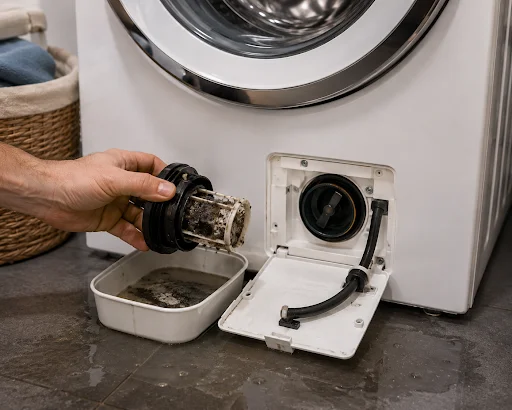
On most front-loaders and many top-loaders, there’s an accessible filter at the bottom front of the machine behind a small panel. Checking and clearing this filter is one of the first things to do when your washer won’t drain. Place a shallow dish or towel underneath before opening it — there will be residual water.
If the filter is clear but the machine still isn’t draining, the pump motor itself may be failing. A working pump makes a consistent humming sound during the drain phase. Silence or a faint clicking during that phase points to a pump that’s trying and failing to run.
A Faulty Lid Switch or Door Latch
Top-loading washers have a lid switch that must register as closed before the machine will spin. It’s a safety feature – but when the switch fails, the machine behaves as though the lid is always open and refuses to enter the spin cycle, even with the lid firmly shut.
This is one of the most common reasons a washing machine won’t spin on top-load models. To test it: open the lid and press the switch manually with your finger while the machine is running. If the spin starts, the switch is the problem. Replacement switches are inexpensive, but the installation involves accessing wiring inside the machine cabinet – proceed carefully or call for help.
Front-loaders have a door latch assembly that works the same way. A latch that doesn’t engage fully will prevent the spin cycle from starting entirely.
A Worn or Broken Drive Belt
Many washing machines use a drive belt to connect the motor to the drum. Over time, belts stretch, crack, and eventually break – and when that happens, the motor runs but the drum doesn’t move. This is the classic scenario behind the complaint that the washing machine motor runs but the agitator doesn’t work: you hear the machine running normally, but nothing is actually spinning.
Checking the belt requires accessing the inside of the machine cabinet, which means removing the back or front panel depending on the model. A broken belt is visible immediately. Replacement is straightforward if you’re comfortable with basic appliance disassembly, but it does require getting the machine away from the wall and partially opened up.
An Unbalanced or Overloaded Drum
Modern washers have sensors that detect imbalance during the spin cycle and stop or reduce spin speed to prevent damage. If the machine is consistently stopping mid-spin, check whether heavy items – towels, jeans, bedding – have clumped on one side of the drum.
Redistribute the load, remove a few items if the drum is packed, and restart the spin cycle. If the machine completes the cycle without stopping, the load was the issue. Washing a single heavy item like a comforter is a common trigger for this – always pair bulky items with a few lighter ones to keep the drum balanced.
A Blocked or Kinked Drain Hose
Even if the pump is working perfectly, a kinked or partially blocked drain hose will prevent water from exiting fast enough. Pull the machine away from the wall and inspect the hose running from the back of the machine to the drain standpipe. It should have a smooth curve with no sharp bends or visible kinks.
Also check that the end of the hose isn’t inserted too far into the standpipe – if it’s pushed in more than about 6 inches, it can create a siphon effect that interferes with draining.
The Washing Machine Cold Water Supply
If your washing machine cold water doesn’t work – meaning the machine isn’t filling properly – the drum may not have enough water to complete a proper wash cycle, which in turn can cause the machine to skip or fail the spin sequence. Check that the cold water supply valve behind the machine is fully open and that the inlet hose screen isn’t clogged with sediment.
This is a less obvious connection but worth checking early, especially if the machine is stopping before the spin cycle even begins rather than during it.
A Failing Motor or Control Board
If none of the above applies – the pump is clear, the belt is intact, the lid switch works, the load is balanced – the problem may be in the motor or main control board. A motor that’s starting to fail can run intermittently, run without enough torque to spin a full load, or stop under load. This produces the frustrating symptom of a washer that works fine on small loads but stops spinning on normal ones.
Control board faults are less predictable – they can cause almost any behavior, including skipping drain and spin cycles entirely without displaying a clear error code. Both require professional diagnosis. Testing motor windings and reading control board fault logs requires equipment and experience that goes well beyond basic troubleshooting.
How to Fix a Washing Machine That Doesn’t Spin: Start Here
Work through these steps before calling anyone. They cover the most common causes and take 15–20 minutes.
- Check and clear the drain filter
Locate the filter panel (usually bottom front on front-loaders) and clear any debris. This alone resolves a significant number of drain and spin problems.
- Inspect the drain hose
Pull the machine out and check for kinks, blockages, or incorrect insertion depth into the standpipe.
- Test the lid switch or door latch
On a top-loader, manually press the lid switch while running – if the drum starts spinning, replace the switch. On a front-loader, check that the door latch is engaging cleanly and fully.
- Check the load
Redistribute heavy or unbalanced items and try the spin cycle again on a smaller, evenly distributed load.
- Listen during the drain phase
A pump trying to run makes a distinct hum. Silence during the drain phase points to a pump motor issue; a grinding sound suggests debris inside the pump housing.
- Check the drive belt
If the motor is running but nothing is moving, access the back or front panel and inspect the belt. A snapped or visibly damaged belt confirms the cause immediately.
If you’ve worked through all six steps without finding the problem, or if the fix requires more disassembly than you’re comfortable with, a professional diagnostic will get you a clear answer without the risk of causing further damage. Our washer repair service covers all major brands and covers everything from pump replacements to motor and control board diagnostics — usually resolved in a single visit.
Does the Brand Affect the Diagnosis?
The core causes of spin and drain failures are consistent across brands, but failure patterns do vary.
Samsung and LG front-loaders are prone to drain pump failures and door latch issues. Samsung models in particular have a well-documented history of spin cycle interruptions caused by the pump filter becoming blocked – something that clears up quickly with a routine filter clean.
Whirlpool and Maytag top-loaders frequently develop lid switch failures and drive belt wear. Washer drains but won’t spin is a common complaint on older Whirlpool top-loaders, and in most cases the lid switch is the first thing a technician checks.
Bosch and Miele front-loaders are well-built and less prone to failures, but when drain pump issues do occur, the pump assembly is more integrated and replacement is more involved than on mainstream brands.
GE and KitchenAid models sometimes develop control board faults that affect spin cycle sequencing – the machine drains correctly but the spin either doesn’t start or stops prematurely without a clear mechanical cause.
For Tampa Bay area customers dealing with any of these, our appliance repair in Saint Pete team works across all major brands and carries common parts on the truck for faster same-visit repairs.
FAQs
Why does my washing machine not spin even though the motor is running?
The most likely causes are a broken drive belt (motor runs but drum doesn’t move), a faulty lid switch or door latch (machine won’t enter spin mode), or an unbalanced load triggering the safety cutoff. If the belt and switch are both fine, a failing motor or control board may be the cause.
My washing machine drains but won’t spin – what’s wrong?
If the water is draining correctly but the drum won’t spin, the problem is most likely the lid switch, drive belt, or a load imbalance. On front-loaders, a door latch that isn’t engaging fully is another common cause.
How do I fix a washing machine that won’t drain?
Start with the drain filter – it’s the most common cause and takes two minutes to check and clear. If the filter is clean, inspect the drain hose for kinks or blockages. If both are fine, the drain pump motor may be failing and will need to be tested or replaced.
Can an unbalanced load really stop the spin cycle?
Yes. Modern washers have sensors that detect drum imbalance and reduce or stop the spin to prevent damage. Clumped heavy items, single bulky loads, or an overfilled drum are all common triggers. Redistributing the load and restarting the spin cycle usually resolves it immediately.
How long does a washing machine repair typically take?
Most common repairs — drain pump replacement, lid switch, drive belt, door latch — are completed in a single visit of one to two hours. Control board and motor repairs may require a return visit if parts need to be ordered, but the initial diagnostic is always done on the first call.